
Vineet Agrawal
Healthcare Innovation Leader • 1st
1/14/2025 • 4 min read
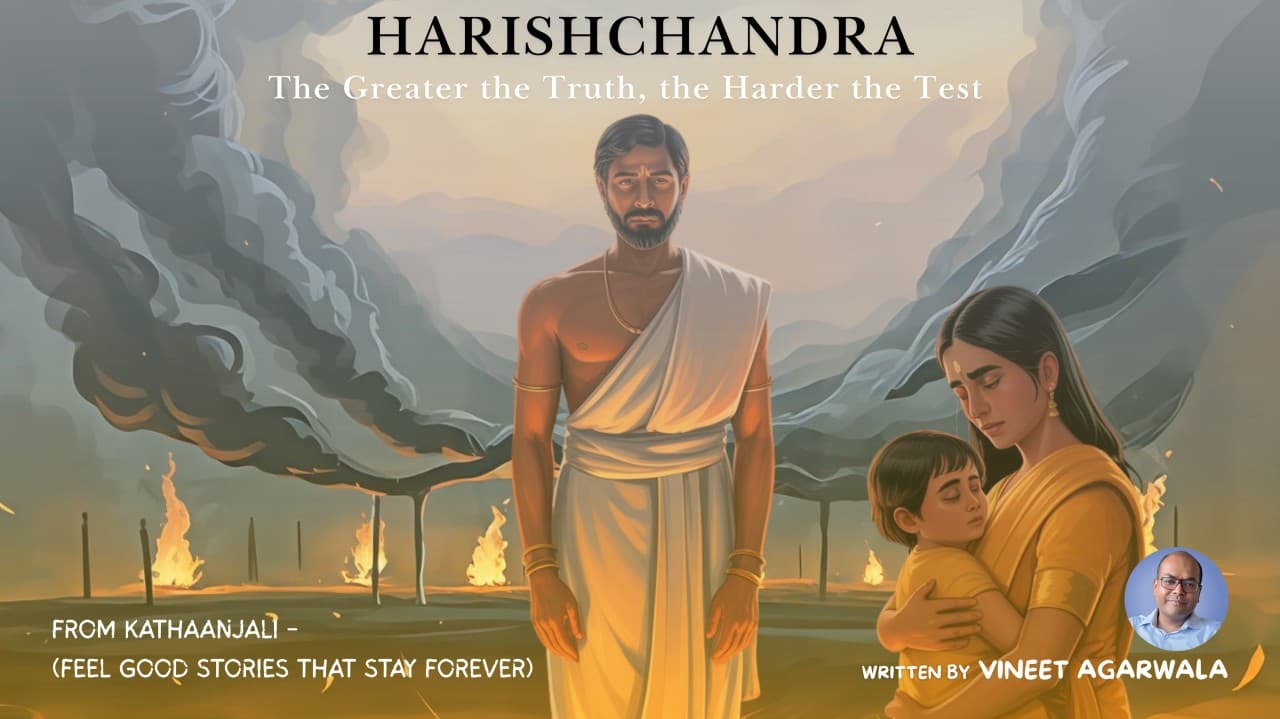
Harishchandra - The Greater the Truth, The Harder the Test
KathaAnjali is my personal archive of stories that hit deeper than advice.
Short, real, and rooted in Indian mythology, history, sport, and everyday life — each one is picked to make you pause, feel, or see differently
Some teach. Some heal. All stay.
In the age of heroes - the Treta Yuga - when lineages like the Suryavansh were crowned with duty, there was a king named Harishchandra. People spoke his name like a promise: where he ruled, truth lived. This is the story of how that promise was tested, how a king gave away his kingdom without flinching, and how the price of that promise brought him to a place of smoke, sorrow and finally, glory.
Harishchandra wore his truth like a second skin. Born in the Suryavansh, his court shone with justice, an his people slept without fear. When sages came to his palace, he rose and gave as a king must give.
Once, while hunting in the forest, Harishchandra paused at a cry. He left his bow. At that moment the great sage Vishvamitra appeared - a man who had practiced severe penances and had extraordinary power.
Vishvamitra tested kings. He stood before Harishchandra and asked for a gift. The king, steady and simple, said, “Ask what you will. If it is mine to give, it is yours.”
When the sage asked for the kingdom itself - the land, the treasures, the army - the king did not tremble. He answered:
“Take it. A king keeps his word. What is mine, I give.”
He gave away crown and treasury, elephants and chariots - everything, calmly, as a man gives a last cup of water to a guest. There was no argument, only the weight of a promise kept.
Vishvamitra then told him: “If you have given the earth to me, you must leave this realm. It is not yours any longer. You, your wife and your son - go away; go live elsewhere.”
So Harishchandra, Shaivya (his queen, also called Taramati), and their young son Rohitashva set out — leaving the city that had been their home, walking barefoot, the dust of the road like a new crown.
They walked toward Benares - the sacred city where Shiva is worshipped; a place that stands near the burning-grounds and where the tests of the heart are often faced. The people of the city cried after them, but the king did not turn back. He had given his word
Days passed. The king had kept his promise but the sage reappeared and demanded also the fee for a royal sacrifice — the Rājasūya. Harishchandra had nothing left to pay. He begged for time. Vishvamitra gave none.
In the market of choices, the king sold what he could. With a voice that did not shake, he said to his wife, “This is the way of duty. This is what we promised.” She answered in a whisper that was a blade and a balm both: “Keep your truth. Truth is the highest virtue.”
A brahman came forward and bought Shaivya. The queen, whose hands had once held royal cups, was led away to serve. Seeing this, the little boy clung to his mother. The queen begged the buyer, “Please take my son too, so I am not alone.” The buyer - hardened by his own life - weighed money and compassion and chose the money. The child was taken.
Harishchandra watched his son carried away. His chest broke. He fainted and woke with a shame that burned hotter than any sun. But still, his mouth said only the words he had promised to speak.
The coins from selling his wife and son did not satisfy Vishvamitra. There was still debt to be paid. The king made the final, unthinkable choice: he sold himself.
A Chandala - a low-caste man who lived by the margins - bought him and took him to the burning-ground. Harishchandra, who had sat upon thrones and received honours, now wore ragged clothes. He carried a staff. He smelled of ash and smoke. He became the keeper of a place many fear to visit.
He worked there day and night. His hair grew matted; the ash painted his skin white in stripes. He learned to lift bodies with the same steadiness he once used to lift a sceptre. He learned the faces of grief so well that he could tell hope from despair by the way someone folded a cloth.
At the burning-ground, he saw everything human in its rawest form. He watched mothers who could not afford to claim their children’s bodies,and relatives who could not cry because hunger had closed their mouths.He kept the books of the dead - who had come, who had paid, who had been turned away.
One Afternoon int the Burning ground
- The sky hangs low with smoke, not wind.
- The ground was hard with ash; footmarks sink then vanish.
- Stacks of wood stood like dark teeth; skulls and bones lay half-buried between logs.
- A chorus of cries - not one voice, but many: wails, whispers, sudden choking sobs.
- Jackals and crows argue over leftovers; the air was heavy with the smell of burning flesh, wet earth, and cold incense.
- Men and women move with a mechanical pain, laying out the dead, placing cloths, closing eyes, turning their faces to the final flame.
There stood Harishchandra - hands that once blessed and sealed now counting coins for last rites, holding blankets taken from corpses, moving swiftly to the sound of a grieving shout.
A mother appeared - ragged, wild-eyed - carrying a small body.A child bitten by a snake. She fell at the gate and cried, “My son - give him the last rites. Here is what I have.”
Harishchandra, bound by his duty to collect the fee, said, in the official voice he now wore, “There is a charge for cremation. Please pay.”
She answered with a keening sound that broke the air. “I have nothing. I have sold everything I had. Please for the love of the gods help me.”
He looked at the child and then at the woman. In the pallor and small hands, he saw his own son. He did not know it at first- the years had changed faces. The queen - his Shaivya -stood there too, beaten and dragged.
When recognition came, it arrived like a blade.
They were each other’s last anchors in the world.
They spoke with voices cut in half by grief.
Shaivya: “Is this the law that you follow, my lord? Is this what your righteousness has made of us?”
Harishchandra, with ash on his face and the smoke burning in his lungs, answered softly, “Duty is a dangerous thing when it asks for all of you. But I will not break my promise.”
She cried, “You sold me as a slave. You sold our boy. How can a man be both husband and judge?”
He folded his hands. “I will do what duty asks.”
There was a moment then - small, terrible - when both of them thought: this is too much.
The queen made a mother’s final choice: she laid the child upon the pyre.The king, hollowed by loss, raised the torch - prepared to join the flame.
They were ready to end the pain together.
At the instant the fire would take them, the world changed. Light poured down. Voices - not human but divine - spoke the secret of the test. The child rose from the ashes. The queen’s face cleared. The king’s chest loosened for the first time in months.
The gods appeared — Indra, Dharma, Vishwamitra, and many others.
They told Harishchandra that his whole life had been a test of truth and patience.
Because he had stayed true even through the worst suffering, the gods restored what he had lost.
Vishwamitra’s anger melted into admiration.
Indra offered Harishchandra a place in heaven.
But the king refused. “How can I go alone?” he said. “My people - the ones who cried when I left - they too have suffered. I will not go without them.”
The gods smiled. “So be it.”
Harishchandra, his queen, his son, and all his loyal subjects rose to the heavens together - bathed in light, honoured for the truth they had stood by.
Thus ends the story of King Harishchandra, who sold his kingdom, his family, and his freedom, who became a servant at the burning ground yet never sold his truth
He proved that truth may demand everything you love,
but in the end, it returns everything you’ve lost - purified, eternal, whole.
If this story stirred something in you — drop a note.
Need your encouragement...
If you have a story, share it…
Vineet Agarwala
Techie. Storyteller. Founder.
About
200+ D2C & Startup Wins | Small Town, Big Tech | Techie. Storyteller. Founder @ TezCommerce & BlueHorse | AI + Speed + Scale for eCommerce & SMEs
Current Roles
- CEO & Co-founder, BlueHorse Software Self-employed
- PeopleSoft Project Manager of ICICI Prudential
- PeopleSoft Technical Lead of Aditya Birla Group
- Sr. Software Developer of CMSS
Achievements
Sun Certified Java Programmer (SCJP) and Oracle Certified Associate (OCA).
Proud to play a part in helping founders bring their dreams to life
Received the award for Fastest Growing AI-Enabled Web & Mobile App Company for BlueHorse
Software at the Indian Business Awards 2025
"My vision is to add value to internet
ventures and transform them using
technology. Quality, Consistency, and
Innovation are the 3 pillars
of my work ethic.
Contact
vineet.agarwala@bluehorse.in
2nd floor (Zest Express), B8 72101 Aurabinda Nagar, Midnapore - 721101
Categories
Popular Tags
Stay Updated
Get the latest insights on healthcare innovation and leadership.